
Missile-aneous Scientific Principles

March 4, 2013

tamiby: Tami O’Connor

One of the things I enjoy most about my job at Educational Innovations is conducting teacher workshops.  It’s not quite the same as being in the classroom in front of twenty-plus students, but it’s fun nonetheless.  My favorite presentation is titled, 3-2-1 Blastoff!  In it, we deal with energy, forces, and motion.  I use the Mighty Missile Launcher to demonstrate these topics.

It is exactly that…  a missile launcher.  The good news is this missile launcher can be used safely in a classroom with children from kindergarten to college level. Participants need safety glasses or goggles.

The launcher is primarily constructed of a film canister, a straw, and a balloon. The balloon has a sponge-like material inside that functions to re-inflate the balloon quickly.  The balloon is attached to the film canister so little air is able to escape.  The film canister pivots, allowing you to aim it at differing angles.  The four missiles are simply straws, sealed on one end, with foam fins that stabilize them as they fly through the air.photo

I first demonstrate how the missile is launched.  The missile is loaded onto the launcher by sliding it onto the straw that is slightly less narrow than the missile.  Since the balloon is connected to the film canister, air can flow easily between the two.  Depressing the balloon forces air into the film canister and out through the attached straw.  When a missile is loaded onto the straw, the forced air propels it into the air.  The harder and more quickly the balloon is squeezed, the faster the air flows into the missile.rkt600

Next, I make groups of three or four individuals, and I challenge my teachers to consistently land three out of four missiles inside a target area 1 meter away.  Seems like a cinch, right?  Not so fast…  As with every good science activity, there are several variables that must be controlled.  The first is the force at which the missile is launched.  The harder and faster the balloon is squeezed, the faster the air is compressed and the farther the missile travels.  The second is the angle at which the film canister points.  The greater the angle, the higher and shorter (in horizontal distance) the missile travels.photo copy 2

So, the question is, how can we control these variables?  In my workshop, I provide rulers and protractors.  The participants quickly learn that controlling the force is not an easy task.  Most people try to use their hands to launch the missiles, but it is difficult to apply the same force for each launch.  That’s where the ruler comes into play.  By finding an object that can be dropped onto the balloon at a constant height, participants are better able to control the amount of force applied to the balloon.photo copy 3

The protractor is used to control the angle that the turret is pointing.  The angle must be smaller if the force is less and the angle must increase if the force increases.  Participants also realize that after most launches the launcher moves.  Using some masking tape to secure the launcher to the table can control this problem.photo copy

The missile launcher most easily teaches Newton’s Laws of Motion.

Newton’s first law states that an object at rest will remain at rest unless acted on by an unbalanced force. An object in motion continues in motion with the same speed and in the same direction unless acted upon by an unbalanced force.  This law is often called, “the law of inertia”.

The missile will remain on the launcher until acted on by a force.  The force that propels it is the unbalanced force of the air inside the missile pushing against the inside of the balloon. In deep space, where there is no air and little gravity, the missile, once launched, will continue on forever, unless it runs into another force (which could be an object traveling in another direction).  Here on earth, the friction from the air molecules slows the missile, and gravity pulls it downward.

According to Newton’s second law, acceleration is produced when a force acts on a mass.  The greater the mass (of the object being accelerated) the greater the amount of force needed (to accelerate the object).   This principle is also expressed using the equation F=ma

Newton’s second law, F=ma can be illustrated by the force with which you depress the balloon.  Since the mass of the missile is constant, the greater the force at which you launch it, the greater the acceleration.  The greater the acceleration, the farther the distance the missile travels.  An interesting way to take this one step further is to add some mass to each missile.  By keeping the force constant, students can see that more massive objects have less acceleration while using the same force.

Newton’s third law states that for every action force there is an equal and opposite reaction force.

As the air shoots out of the base of the missile a force is applied to the film canister and to the air behind the missile.  As a result, an opposite force is applied to the missile.  Since the missile has less mass than the launcher, the missile is propelled into the air.

This activity is a favorite of teachers and students alike.  It looks easier than it is, and, by the end of the activity, participants gain skills working in teams and experience with force and motion.

facebook-resized-154


Lights, Camera, Action!

July 21, 2012

by: Bruce Yeany

Micro LEDs and Motion

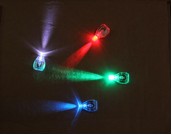
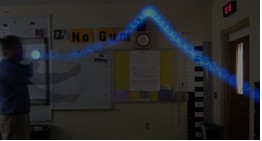
The tiny LED lights  known as Rave lights have become popular with students at dances and parties.   With the  lights turned down, kids have these lights on their hands or in gloves, and the results are totally awesome when they wave their hands around,.  Watching this phenomenon takes me back to the era of the disco ball and laser light shows.  It became apparent to me that these little lights would be fantastic when incorporated into the study of motion. Using these lights and a digital camera, it would be fairly easy to record the motion of moving objects for closer study.  Rolling, spinning , swinging, falling, projectile motion, etc. can all be captured using a camera and these little lights.

Can you figure out how these were done?

Here are some pictures I have taken over the past year.  Almost all were taken using these small lights.  In some cases the shutter was only open for a fraction of a second and in others it may have been open for several seconds.  Many of the following pictures were made using a laser pointer.

This picture depicts fire being thrown by a small trebuchet.

And of course, it’s also fun to try and write messages….. one small problem is that they appear backwards to the camera.

Bruce Yeany has been teaching physical science in the Annville-Cleona School district for the last 35 years.  He enjoys working with students and  building materials for his classroom.  Over the years he designed several  pieces of classroom science equipment that are produced and sold commercially including the World’s Simplest Motor and the Fountain Connection.   Bruce is also an amateur photographer as is his wife, Mary.  As the middle school yearbook adviser, he is quite used to having a camera around his classroom.  By combining his  hobby in photography and looking for new ways to demonstrate the motion of objects, Bruce has found that using small LED lights and a digital camera can help him freeze the movement of motion and turn it into works of art.


Phenomenon Of The Disappearing Dot! – Is it Physics, or Math, or Perception?

February 9, 2011

by: Lee Walker and Partnership for Learning.com, LLC

Use a hack saw to cut a 2¼ to 2½  inch length of ¾ inch outside diameter PVC pipe.  The point is for the tube to be three times the length of its diameter. While 2¼ inches is more precise, it is fine to fudge just an extra ¼ inch. Trust me, it’s close enough.  Next put a green dot at one end and a red dot on the other (see photo). I like to drill two small depressions and put the paint in those two shallow holes (don’t drill through).

Set the cylinder down in front of you on a nice smooth surface.  You will need plenty of room as you develop the operational skills, so a reasonably smooth desk or table top should be fine.

Now, place the tip of your index finger on the red dot. It works just fine on the green one, but let’s have the first run match the photographs. If you force down your finger as you pull it slightly back toward you, the cylinder will spin rapidly around a horizontal axis in your direction. You can visualize the action around this axis by imagining the cylinder seen from one end so that it would look like a spinning wheel.

The two drawings below show how the cylinder, viewed from the end, rolls (spins) around a horizontal axis in a direction toward the finger that snaps downward (though sliding away at the same time).  As this is going on, (see the drawing on the left) the end that had the fingertip on it, rotates around a vertical axis in a direction away from the fingertip.

At the same time that the view of the red dot end of the cylinder may be thought of as a wheel spinning around a horizontal axis toward you, the whole cylinder will spin around a vertical axis and skitter away from you. The spin around the vertical axis (seen from above) is shown in this photograph just after my finger popped downward to the table top.

O.K.  Here’s the fun part. As the cylinder settles into a stable, whirling action, you will see three of the red dots appearing. If connected the dots would be at the vertices of a triangle.  Notice that the green dots do not appear at all. Now, try repeating the whole thing but push down on the green dot. When the action is stabilized only three green dots will show up at the vertices of our imaginary triangle.  Pretty neat, isn’t it?

Here are some tips to help investigate what is perhaps going on. When you have spun the cylinder, it has skittered out away from your hand, and settled into a stable, high speed spin, you have probably noticed that there seems to be an illusion of a round, rather ball-shaped zone in the middle of the blurry spin. This illustration (obviously touched up with the red dots) presents a view of that ball region viewed from overhead as the cylinder spins on a smooth table top.

When your cylinder is doing this try observing from the side with your eye down at the level of the table.  One end of the cylinder is in contact with the table during the high speed rotation around the vertical axis and the other end is not in contact with the table’s surface.

The drawing on the left is my attempt to show the cylinder running with one rim in contact with the table and the other end slightly elevated. As this occurs, you can see that the white cylinder is in many places, but the central part of the spin is routinely occupied by white PVC. Does this help you get an idea about that ball-shaped central part?  There may even be some accounting for speed differential if the part in contact with the table makes a longer circuit  than the up end for each spin about the vertical axis. Hmmmm.

Now, this next part is almost as strange as any of the above, and probably no one of the matters I’m going over works alone to present the phenomena that make the spinning cylinder so much fun.

The idea here is that the end with the red dot (the finger just rolled it) is turning around the horizontal axis toward the launch person (see the little blue arrow in the tube), BUT the cylinder at that end is spinning away from the person around the vertical axis (see yellow arrow). The speed of those two actions work against each other (are subtractive).  The red arrow shows that the other end is turning around the horizontal axis toward the person, AND that end is also turning around the vertical axis toward the person (see green arrow). Those two speeds are additive.

Speed of motion and perception must be linked. After all, things that go rapidly past the eye may be blurred or barely visible at all, while things that are stationary or slow moving may be seen quite clearly. Is it a coincidence that one dot is gone and one is seen THREE times when we use a cylinder that is three times as long as its diameter?

Just for fun, here is one more bit.  The circumference of a tube may be found by multiplying its diameter  times pi (3.141 will do for our purposes) .  Now the relationship of the diameter to length may be made quite interesting by thinking, “ Does the tube roll completely around the horizontal axis three times to make one rotation around the vertical axis?” Some experimenting could be very beneficial. Still using a tube of the same diameter with the same placement of red and green dots, what would happen if that tube were only twice as long as the diameter?  How about four times as long?

Enjoy the PHENOMENON OF THE DISAPPEARING DOT! Have fun exploring and using your creativity!  Please contact lee@partnershipforlearning.com if you think you make a breakthrough.  Lots of what I’ve read about this doesn’t really satisfy my curiosity.

Educational Innovations carries the Physics Quest 2010 Kit – Spectra’s Force, which includes the materials for this experiment as well as 3 other experiments.


Follow

Get every new post delivered to your Inbox.

Join 42 other followers

%d bloggers like this: