

Two Prisms – Four Demos

November 26, 2011

by: Martin Sagendorf

Most everyone knows that an equilateral prism will refract white light into its constituent colors: a spectrum ranging from red to violet.  But, if one uses an additional prism, there’s much more to be discovered.

All that’s required:

-       a source of white light

-       a slit mounted on a large piece of cardboard

-       two equilateral prisms

-       two small pieces of card stock

-       a square of ground glass.

SIMPLE REFRACTION

The light source and slit are arranged as shown.  A fairly narrow (1/4”) color spectrum will be displayed on the ground glass.  Note that the light beams are DIVERGENT.

DOUBLE REFRACTION

The color spectrum from one prism is now passed through a second prism.  The various color beams are further spread to result in a somewhat wider (5/16”) spectrum display on the ground glass.  The light beams are even further DIVERGENT.

A SINGLE COLOR EXPERIMENT

Isaac Newton wondered if any single color of a spectrum could be further broken into more colors.  To investigate this, he placed ‘STOPS’ in the light beams between the two prisms – allowing only one color to pass to the second prism.  The result was that once white light was broken down into its constituent colors, the colors could not be further broken down.  Here only one STOP is used – leaving only red, with a small fringe of blue.

RECOMBINING SPECTRUM COLORS

Isaac Newton also wondered if the colors of the spectrum could be recombined to again make white light.  To do this he used a second prism arranged as shown.  He proved that this was possible.  What’s interesting is that the light beams exiting the second prism are not on the same line, but they are PARALLEL.  And, because the slit is not infinitely narrow, these beams are not infinitely narrow and therefore can mix to create white light.

THE COMPONENTS

  • A 100 Watt halogen bulb provides a good light source.  It must be shielded because the room light should be a low-level to see the spectrums on the ground glass.  As shown, a box top is used – a fully enclosed bulb would be better, but there must be provision for removing the heat generated (about 90 Watts for a 100 Watt bulb).  Experiment to find a slit width that works well for your set-up.

  • Two razor blades (single or double-edged) spaced with their edges about 1/32” apart make a good slit.  Tape the blades over a one inch by ¼ inch cutout in a piece of cardboard.  And be sure to use black tape to cover any openings in the blades.
  • Two equilateral prisms.
  • Two 3” x 3” square pieces of thin cardboard to act as STOPS.
  • A 2” x 2” or 3” x 3” piece of ground glass or frosted vellum paper.  Ground glass is easily made using automobile engine valve lapping compound – place some compound between two pieces of ordinary window glass and rub them together.  Only one side should be frosted.  The sharp edges and corners of the glass pieces can be ‘broken’ with fine sandpaper wrapped around a small piece of wood.

NOTES:

A standard tungsten filament light bulb will not work as well as a halogen bulb – the halogen provides a much better spectrum.  Rotate the bulb to obtain the highest illumination of the slit.

The STOPS can be hand-held or taped to small blocks of wood.  In either case, the vertical edges that block the light must be parallel to the color lines so only one color is passed.

The ground glass can be taped to a small piece of wood – in this case, the vertical dimension should be increased to 3”.

It is important that the heights (the centerlines) of the bulb filament and the slit be the same.  And since the bulb’s filament will be four or five inches above the bench top, some large books or other flat objects can be stacked so the vertical center of the optical components match the center height of the slit.

The distances shown in the illustrations work well.  The distances to the ground glass can be increased for larger images, but with subsequent decreases of image intensity.  Obviously, a darker room will allow easier viewing of fainter spectrums.  As shown in this photo:

The spectrums shown are slightly curved because the prisms’ faces are very slightly curved.

IN SUMMARY

These are great demos in that they not only illustrate some fundamental properties of light, but that they also provide for many variations of the set-up.  The distances and angles shown provide a starting point for experimentation.  For example, increasing the distances will enlarge the spectrum display – but, which works best to do this?

IN THE CLASSROOM

These experiments can be done as a demo for the class as a whole, but even better, since the components are so inexpensive, several set-ups can be provided for lab groups of three or four students.  Equally fun for the instructor is the creation of the lab worksheet guiding the students through the investigations.

Marty Sagendorf is a retired physicist and teacher; he is a firm believer in the value of hands-on experiences when learning physics.  He authored the book Physics Demonstration Apparatus.  This amazing book is available from Educational Innovations – it includes ideas and construction details for the creation and use of a wide spectrum of awe-inspiring physics demonstrations and laboratory equipment.  Included are 49 detailed sections describing hands-on apparatus illustrating mechanical, electrical, acoustical, thermal, optical, gravitational, and magnetic topics.  This book also includes sections on tips and hints, materials sources, and reproducible labels.


Invite Newton Into Your Classroom

May 28, 2011

by: Matthew Morris

Newton was a revolutionary thinker of his time. He is responsible for the three laws of motion that we still use today;

1. Objects that are not in motion remain stationary unless acted upon by another force.

2. There is a direct relationship between the force acted upon the object and the mass of that object times the acceleration the object feels (F=ma).

3. For every action there is an equal and opposite reaction.
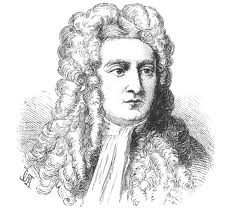
Nobody before Newton could explain why objects acted the way they did, but with these three laws he quantified movement in terms everyone could understand.

But there was a problem with his theory; if all motion had to be caused by some force acting on it, then why do objects fall towards the earth when you release them from a fixed position? This free falling object was in fact free, meaning free of outside forces acting upon it (besides wind resistance). There were no visible forces acting upon that object. So why do they move downward if nothing is acting on it? But Newton explained this motion with gravity. He said that gravity is a force that the earth has upon all objects, something invisible that pulls us down at all times at a constant acceleration. There is a myth that the way Newton thought of the idea of gravity was when he was thinking about it under an apple tree when an apple fell on Newton’s head and at that moment, he figured out that there must be a force pulling the object down. This is also why apples are used to demonstrate Newton’s force, but no one knows definitively if the myth is true or not.

At the time Newton didn’t know that the acceleration of Earth’s gravity would later be calculated at approximately 9.81 m/s2. Also, at the time, he couldn’t explain what this force was made of, but only that it was invincible and constant. It was many years later that Einstein explained gravity with the theory of relativity stating that space and time were really one thing called spacetime, that bound all objects together like a web such that when an object has mass, it stretches the spacetime causing objects around it to feel a ‘pull’ towards the center object. Also Einstein discovered that this force increases as the outer object gets closer to the center object. Think of it like a blanket being stretched really thin and a ball being placed in the center and another ball being rolled across the blanket from one side to the other. This would cause the one moving ball to move towards the ball in the center because of the bend in the blanket, or spacetime.

So, looking back at Newton and the apple, the earth’s mass causes a big bend in spacetime, which causes other objects, such as apples, to be pulled downward at all times, even when they are on the ground already. Hey, something has got to keep them from floating upward.

Now that we’ve explained the motion, let’s define it in equations so that we can predict how the object will act during a free falling motion. The first and most important thing to remember about free falling objects is that the mass doesn’t matter. A bowling ball and a pencil will fall, or accelerate at the same rate towards the earth. Meaning if you go on the roof of your building and drop a bowling ball and a pencil off of it at the same time, they will hit the earth at the same time. But someone might say, “What about a feather? It won’t fall at the same speed as a bowling ball.” And they would be right. But what they are forgetting is air resistance. The bowling ball has very little air resistance because it is very aerodynamic, but the feather is not very aerodynamic. If you were to repeat this test in a vacuum then the resistance due to air (drag) would be removed as a factor, and the objects would fall at the same speed and hit the ground at the same time.

So back to the equations; Using calculus, we can start with the equation for the acceleration of gravity and integrate an equation to define the velocity of the object and then integrate it again to find the position of the object. If we define x as time measured in seconds, then the equation for the acceleration of the object looks like this A(x) = 9.81. One might notice that there is no x in the actual equation and this is because no matter how long the object is falling, the acceleration of the object at any time will always be 9.81 m/s2. So by integrating that function of x, we get V(x) = 9.81x + C. In this case, we are defining the velocity of the object in a function of time. C represents any starting velocity of the object, such as if the object was thrown downward. This can also be defined as V0, or initial velocity.  Then if we integrate that function again we get a position function that looks like this, S(x) = 4.905x2 + Cx + K. In this last equation, K represents an initial position, such as if you defined the height of the object being 10 meters above the starting point, then K = 10. And C still represents the initial velocity.

From these equations, we can know that, if we eliminate the wind resistance, any object, the free falls for 1 second will have an acceleration of 9.81 m/s2, a velocity of 9.81 m/s, and a position of 4.905 m. After 2 seconds it will have an acceleration of 9.81 m/s2, a velocity f 19.62 m/s, and a position of 19.62 m. And at 3 seconds, an acceleration of 9.81 m/s2, a velocity of 29.43 m/s, and a position of 44.145 m. You can predict all of these values at any time using these equations just by plugging in the number of seconds into x.

Keep in mind that all of these equations are generalizations of free falling objects. Certain objects, in real life, because of wind resistance, will fall at different rates. Also, due to wind resistance objects will reach something called terminal velocity where the velocity cannot go any higher because the wind speed it feels restricts any increase in velocity. For humans, the terminal velocity is typically around 54 m/s or about 120 mph. For a raindrop it is around 25 m/s. Also, the earth’s gravity, though seemingly constant, isn’t actually constant. It has very miniscule changes as you change locations on the earth’s surface due to the density of the Earth at that spot. But these changes are so small students shouldn’t even bother trying to account for them.

So, what is a Newton anyway? It is the force created by the weight of an average apple (mass of approximately 102g). Technically speaking, a Newton is the force required to accelerate a mass of 1 kilogram at a rate of 1 Meter per second per second.  What better way for your students to visually understand Sir Isaac Newton’s idea of F=ma, than to drop a 1 Newton foam apple onto someone’s head? They will remember it forever!    Educational Innovations sells The Newton Apple as singles and in a five pack.  The five pack includes a full Starter Guide, which includes experiments to conduct using the Newtown Apple, information about Sir Isaac Newton, and information about the Newton as a unit.

Experiments For Your Students:

Elementary/ Middle School Students

1.     Have students hold their hand straight out. Ask them to describe what they feel on their hand. Then place the Newton’s Apple on their hand. Ask them to describe what they feel on their hand now. Ask them what they think will happen if another apple is added to their hand.  Ask them to explain why this is the case.

2.     Take a Newton’s Apple and a pencil or another small object and weight each object so the students can see the difference in weights. Ask them to predict what would happen if you dropped the objects from the same height at the same time (i.e. which would hit the ground first?). Have a student release the objects at the same time from the same height. Ask the students to describe what happens. Try to relay the concept that the mass of the objects didn’t really matter because no matter what they weigh, the objects will still fall at the same speed and hit the ground at the same time.

3.     Repeat the same experiment as before but use something with a lot of air resistance, such as a piece of paper. Then crumble the paper up into a ball and drop both objects again. This time explain to the students that because the paper had a lot of air resistance before, it took longer, but then when it was made in a ball, the paper was still the same weight but now less air resistant.

High School Students

1.     Take a block of wood and tie it to a piece of string. Then tie the other end of the string to the Newton’s Apple. Put the block of wood on a table and then hang the Newton’s Apple over the edge. Make the table surface smooth enough that the block will slide, but not too fast. This experiment is to demonstrate friction between two surfaces and how it would affect the almost free falling object. Place the block on a table with a different surface (one that is less smooth).  Notice the difference.

2.     Attach a spring to a pole or hanger such that the spring can dangle freely. Then attach the Newton’s Apple to the other end of the spring. Pull down the Newton’s Apple so that when you release the Newton’s Apple it will move up and down in a continuous pendulum-like motion. Ask the students to describe the motion and to predict what would happen if you double the weight at the end of the spring. Add a second Newton’s Apple to the end of the spring and repeat the motion of the spring by pulling down the Newton’s Apples the same distance as before.


Follow

Get every new post delivered to your Inbox.

Join 42 other followers

%d bloggers like this: