
Seeing a Magnetic Field in 3-D

June 12, 2010

by: Martin Sagendorf

This is actually quite easy to do.  This clearly illustrates that magnetic fields are not flat (as too frequently demonstrated in the classroom).

This easy-to-make construction requires only four components:

  1. A clear plastic bottle (about 1-3/4” in one dimension) – the one illustrated below is a 12.6 fl oz ultra concentrated Joy ® dishwashing soap bottle – Note that any bottle originally containing soap or detergent will require repeated rinses to completely remove all of its original contents.
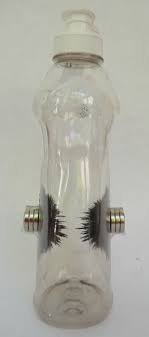
  2. Six 17 mm x 3 mm Neodymium ring magnets
  3. A very small quantity of fine iron filings
  4. 2 lengths of ¾” x 3” clear tape (clear ‘packaging tape’ works better than the usual roll-type transparent tape)

The low cost of these materials and their reusability makes this an ideal class-wide experience.  Further student explorations are readily accomplished by using a variety of magnet types, numbers, locations, polarities, and shapes.  Applicable magnet types (also available from Educational Innovations) are

Ceramic Bar Magnets (0.875” x 1.875”)

Ceramic Ring Magnets (1.25” O.D.)

Neodymium Ring Magnet (0.75” O.D.)

Neodymium Large disk (1” O.D.)

Similar demonstrations can utilize larger magnets and larger bottles.  This one uses a 2-1/2 inch diameter bottle and two large (2” O.D.) ceramic ‘donut’ magnets removed from the magnetron in a discarded microwave oven.

And this one illustrates the magnetic field created by a 2” O.D. ceramic ‘donut’ magnet placed under a 2-1/2” diameter bottle.

CAUTION: Rare earth magnets are very strong and very brittle.  They will attract each other quite unexpectedly.  There always exists the possibility of fractures and flying pieces. Everyone MUST wear safety glasses/goggles when working with these magnets!

Marty Sagendorf is the author of the book Physics Demonstration Apparatus. This amazing book is available through Educational Innovations and includes ideas and construction details, including all equipment necessary, for the creation and use of a wide spectrum of awe inspiring physics demonstrations and laboratory equipment.  Included are 48 detailed sections describing hands-on apparatus illustrating mechanical, electrical, acoustical, thermal, optical, gravitational, and magnetic topics.  This book also includes sections on tips and hints, materials sources, and reproducible labels.


It Floats – Why?

March 25, 2010

by:  Martin Sagendorf

We often think we see forces.  However, in reality, we only see the results of forces.  To understand forces we must believe in Newton’s Third Law.  It states that all forces can only exist in opposite pairs and be equal in magnitude.  And… what is very interesting is that Newton’s Third Law does not stipulate that the forces be of the same kind.

Also, by Newton’s Second Law: If the (net) forces are equal, there will be no accelerations (Fnet = ma = 0)… in other words… equal and opposite (net) forces create a state of equilibrium.  An interesting example of equal and opposite (and unlike-type) forces is that exhibited by a combination of opposed magnetic fields within a gravitational (force) field.  These two different (types) of fields interact purely as ‘force fields’ – only their forces matter… not their types.

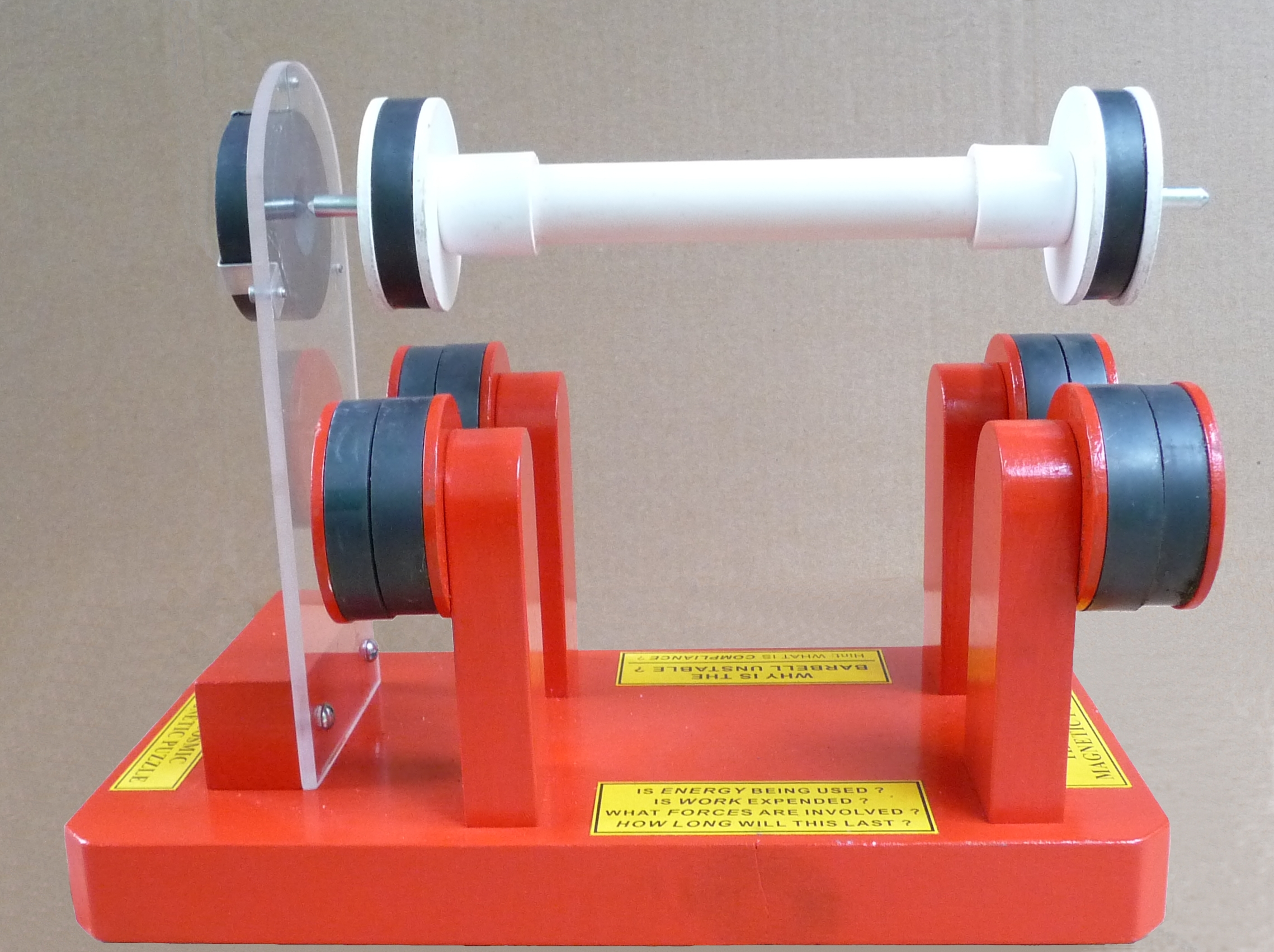
The Cosmic Magnetic Puzzle exemplifies a combination of such forces: a barbell containing two ‘donut’ magnets supported in mid-air above stationary pairs of magnets – with an additional pair of donut magnets maintaining the horizontal location of the barbell.

If you don’t feel like building this apparatus, there are commercially available products that demonstrate this concept at a smaller scale.  Educational Innovations carries the Revolution Top, which has flashing led lights that also demonstrates persistence of vision.

This Demonstration Illustrates:

  • Attracting Magnetic Forces
  • Repelling Magnetic Forces
  • Balanced Magnetic Forces
  • Gravitational Force
  • Two Balanced Forces
  • The Concept of Energy
  • The Concept of Work
  • The Concept of Equilibrium

And Asks:

  • Will this work in space?
  • How long will it work?
  • How are the magnets’ pole faces arranged?

Guidelines for building the Cosmic Magnetic Puzzle are detailed in the book Physics Demonstration Apparatus.  This amazing book is available through Educational Innovations and includes ideas and construction details, including all equipment necessary, for the creation and use of a wide spectrum of awe inspiring physics demonstrations and laboratory equipment.  Included are 49 detailed sections describing hands-on apparatus illustrating mechanical, electrical, acoustical, thermal, optical, gravitational, and magnetic topics.  This book also includes sections on tips and hints, materials sources, and reproducible labels.


Follow

Get every new post delivered to your Inbox.

Join 43 other followers

%d bloggers like this: