
 by: Ron Perkins
A short time ago I received the following inquiry regarding our Heat-Sensitive Paper. One of the joys of being the president of Educational Innovations is having the opportunity to answer questions like this.
Q: What chemical coats your Heat-Sensitive Paper that makes it change color? My chemistry class wants to know the chemistry of what is happening on our heat-sensitive periodic tables. Can you please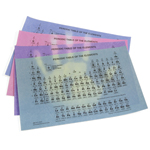 help us?
A: Some of the characteristics of our heat-sensitive periodic tables are easy to understand and some more challenging. The inks used provide color at lower temperatures and are colorless at higher temperatures. The change over temperature is called the “critical temperature.” Adding heat to the paper causes the paper to loose its color, an “endothermic” reaction. The reverse, going from colorless to colored, is an “exothermic” reaction and returns the heat.
To manufacture this paper, long rolls of white paper are unwound, coated on one side, dried, cut, and finally stacked into reams. This is done at a company that produces labels for cans. The paper is then printed with black ink to produce our periodic tables.
Educational Innovations, Inc. was one of the first companies to sell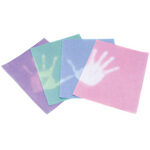
thermochromic paper and drinking cups (see our Disappearing Dinosaurs Mug and our Global Warming Mug), over 15 years ago. We followed up on an article about this new discovery in the NY Times. At that time the “Touch-It” paper used two colors of heat sensitive inks: blue and red – both turning colorless when heated. From those two heat sensitive inks, five colors of paper could be manufactured: red paper which turned colorless; blue paper which turned colorless: orange paper which turned yellow; green paper which turned yellow; and purple paper which turned colorless. For the orange and green paper, the thermochromic inks were printed on yellow paper.
The complete chemistry of thermochromic, heat sensitive ink, involves micro-encapsulation techniques. Incidentally, you can increase the sensitivity of your periodic table by removing any absorbed moisture with a hair dryer or putting the paper through a copy machine.
I have found that kids of every age find this paper fascinating. Teachers use this paper to print newsletters home to parents, for special certificates or awards, and for printing diagrams or other papers the students should keep. They can even be laminated to use as bookmarks, hall passes, or as class syllabus.
If this is a chemical reaction how can it keep going back and forth without the reactants being used up? What type of reaction is it? single displacement? double? decomposition? what new substances are being formed?
I love this paper and use it all the time (from you of course!) but have never, really, understood it. Love the blog and thanks in advance for your time.
Hi Michelle,
The best answer we have found is here. http://www.suite101.com/content/colourchanges-with-temperature-a16244#ixzz10SKI29Zg See the section on Leuco Dyes. Hopefully this will answer your question. All the best. EI
I am looking for heat sensitive prescription bottle lids. Do you make these? Sometimes I forget if I have taken my medicine. If my fingerprint was on the prescription bottle top, then I would know that I had taken it recently. Thanks.
Can you use this paper to create a secret message? for example, write on it with some type of ink/liquid that will only show up once you put your hand on it to heat it up?
Since the ink reacts to heat, there is no way to do that with this paper. We do have Goldenrod Paper that you can use for that purpose. By writing your message in wax (a clear crayon or candle) and then spraying windex or ammonia to reveal the message will work. http://www.teachersource.com/product/color-changing-goldenrod-paper/chemistry Alternatively, we carry a Spy Pen that can be used on any paper. It writes using invisible ink that will become visible when exposed to ultraviolet light that is attached to the other side of the pen. http://www.teachersource.com/product/spy-pen-invisible-ink-pen/chemistry
Hope that helps!
~Tami
Educational Innovations